The Walls of Ston
When Peljesac was overtaken by the Dubrovnik Republic in 1334, there were plans for securing it by digging more channels, but soon it was decided to built the system of forts.
They were supposed to defend Peljesac and the fields of salt, precious strategical Dubrovnik Republic merchandise.
With the sizable funding available, well known builders were commissioned: Mihac and Bunic were domestic engineers, the Italians Onofrio of Napoli and Bernardin of Parma, the French builder Olivier, and Michelozzo of Florence. Masters Juraj Dalmatinac and Paskoje Milicevic worked on the final polishes by the end of the XV century.
 |
 |
 |
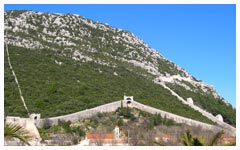
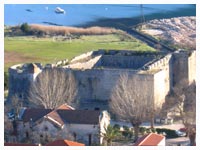
Ston is surrounded with 980 m long walls shaped in irregular pentagonal with fortified corners and the half circle shaped fort Podzvizd.
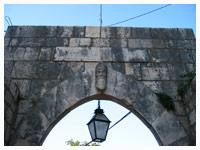
Through history there were two gates to enter the city, and above Field gate, built in 1506 there is a sign in Latin: "ne male defensum litus populariteret ultra hadriaticas tendat proximus horror aquas apposuit bimaris tot propugnacula stagni ragusa et blasi numina magna sua" written by a Dubrovnik poet Ilija Crijevic. Translated: "to not destroy poorly defended coast and across the Adriatic to not come across the feared power (referring to the Turkish power) such fortresses on two seas Dubrovnik has built for Ston and for the very protection of its St. Vlaho".
 |
 |
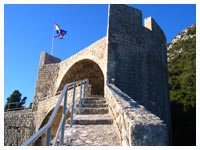 |
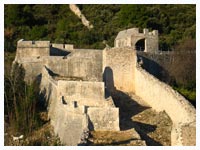
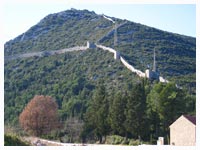
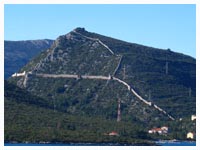
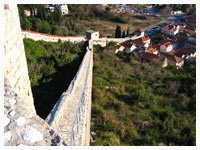
The walls are strengthened by about 40 towers and 5 forts. They climb across the hill with the total length of 5.5 km merging with the wall of Mali Ston and the fort Koruna, which with its 5 towers reminds of a crown. At the top is the fort Bartolomija named after a saint patron of arms. The Big Kastio is also called Kastel of St. Jeronim. The building started in 1347, and by 1613 it looked the way it does now. This fort is the biggest building and the main point of the fortifications system of Ston, and it used to be a home for "kastelan", grain storage and ammunition storage.
 |
 |
 |
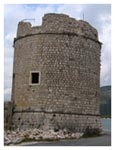
The walls of Mali Ston are square shaped, and were built from 1336 to 1347 on the mainland side, and until 1358 on the sea side. That is when the Luka Gate was built with the late Romanic statue of St. Vlaho. On the shore is Toljevac tower, built in 1478.
The destruction of the walls started after the fall of Dubrovnik Republic. The Austrian administration sold them as a building material for schools and office buildings, also for a arch on the occasion of the Austrian tsar visit in 1884. Further destruction was stopped in 1945, with the Law for protection of historical sites.